Agentic Aerial Cinematography
From Dialogue Cues to Cinematic Trajectories
An agentic framework that translates natural-language filming requests into scene-grounded viewpoints and executable drone trajectories, combining visual feedback with optimization and motion planning.
Equal-contributing author · Listed as George Z. Xue
Motivation
Filming requests often describe a feeling or visual outcome rather than a camera path. A request to make a house feel spacious leaves the system to decide what to show, where to place the camera, and how to move between shots while respecting obstacles and flight dynamics.
Approach
Vision-language shot retrieval and ordering, preference-based Bayesian camera-pose refinement, and collision-aware, dynamics-constrained trajectory planning connect filming intent to onboard control.
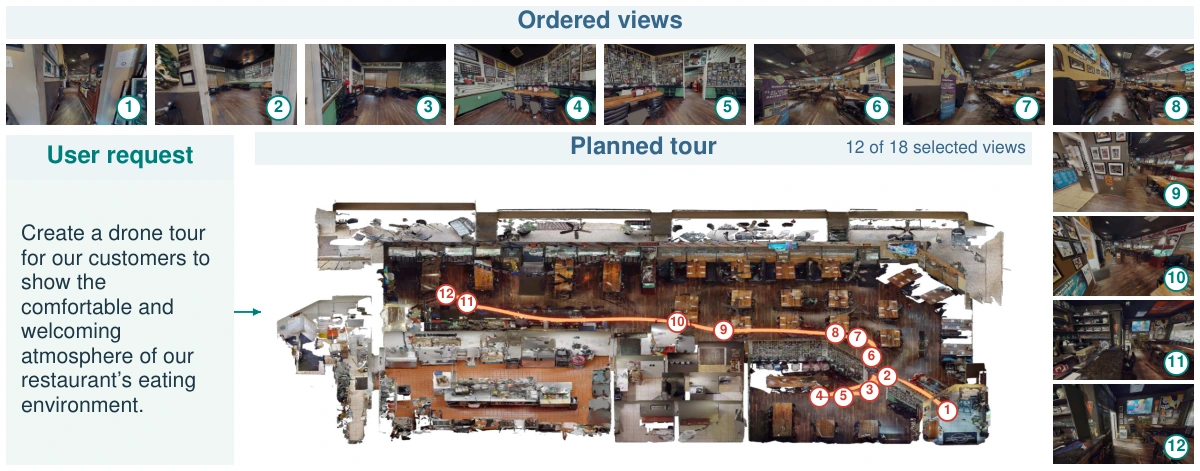
Each shot begins with a description grounded in frames from a posed exploration video. A vision-language model selects and orders candidate views, then compares rendered alternatives as Bayesian optimization adjusts camera position and yaw. These visual decisions happen before flight. A separate planning stage searches free space, builds obstacle-clearance corridors, and connects the refined viewpoints under quadrotor dynamics; onboard feedback control then tracks the resulting trajectory.
Evaluation
Six simulated tours, a 41-participant user study, and hardware-in-the-loop flight tests. Prompt-alignment ratings range from 3.8 to 4.2 out of 5.
Scope
The framework assumes a static, mapped scene. Hardware-in-the-loop tests use a physical quadrotor, while cinematic views remain simulated; the study does not establish a comparative aesthetic advantage over human filming.